
6
May
New Moon - 3:29pm EDT
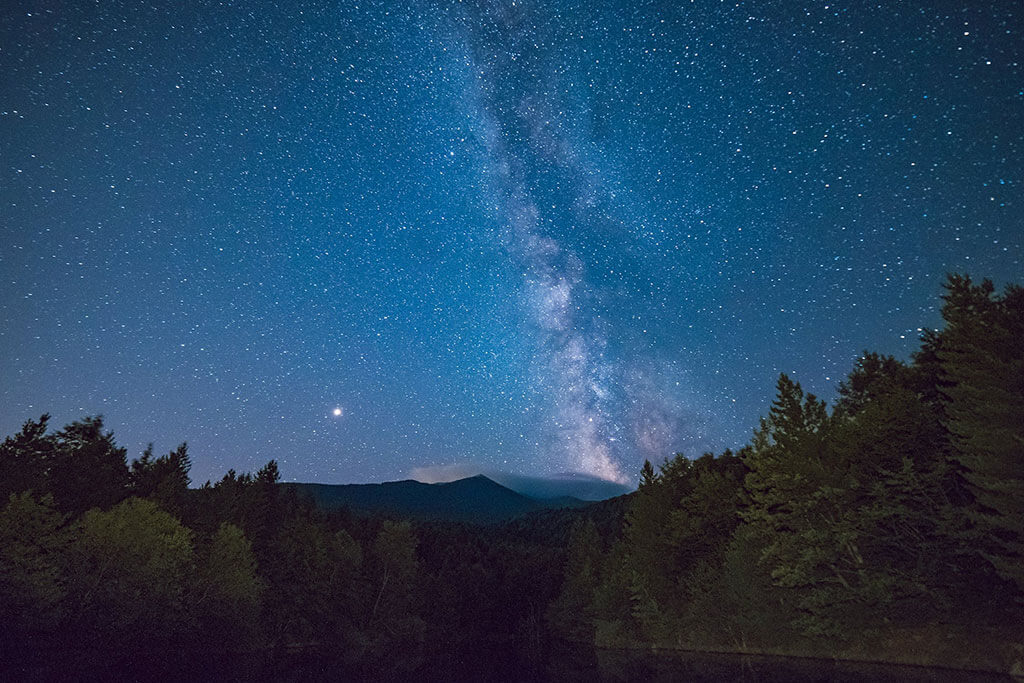
Moonless night allowing to see deep sky objects
5
May
UofT AstroTour: Doing the Impossible: The Case for Investing in Space Exploration
Between 1969 and 1972, 12 men traveled over one million kilometers to walk on the surface of the Moon. Today, we couldn’t go back—over the last 40 years, astronauts have not ventured beyond a thin shell surrounding our planet. How is this possible? I will make a case for dreaming big and investing in space exploration, even in the face of our pressing problems closer to home.
5
May
RASC Hamilton: The Secret Lives of Galaxies
Professor James Wadsley is a computational astrophysicist at McMaster University. He makes computer simulations of things that take millions of years to unfold on the sky. He will talk about "the secret lives of galaxies" which demonstrates the evolution of a galaxy in both what we see, and in ways we can't, over the full age of the universe.
5
May
Harold Healy Frozen Banana Star Party
Mew Lake Campground in Algonquin Provincial Parkhttp://www.gatewaytotheuniverse.org/star-parties-special-events.htmlhttp://www.algonquinpark.on.ca/visit/camping/mew-lake-campground.php
3
May
First Light 1
New Members orientation program – First Light - Spring 2016
2
May
Dark Sky Star Party (GO for Thursday)
See the milky way and galaxies with the unaided eye. Point your telescope to find the many dim deep space objects that sprinkle the sky. Away from Toronto's light polution, there is so much to see. We observe from the Long Sault Conservation area, an hour outside of Toronto. We meet around dusk once a month in the parking lot for views only seen in dark sky conditions. We hold this event on the first clear night of our week-long window, so the date and time are determined closer to.
1
May
Texas Star Party
Prude Ranch near Fort Davis, Texashttps://texasstarparty.org/
30
April
RASCTO Astrophotography Session #5
Lunar, Night Sky Landscape, and Deep Sky Photography with DSLR + Editing with Photoshop and LightroomPresenter: Ben Lappalainen
29
April
RASC Mississauga: Good Things Come in Small Packages
Meteroids, asteroids, comets and dwarf planets are some of the smallest bodies in our solar system and are the focus of several recent space missions: Rosetta, Dawn, and New Horizons. Learn about how Pluto, Ceres and these other tiny wonders continue to amaze and surprise us.
29
April
Globe at Night
Measuring light pollution of your sky, see www.globeatnight.org
28
April
UofT Planetarium: The Search for Planet 9…Again
Showtimes: 7:00pm, 8:00pm, and 9:00pm
Recently, Dr. Mike Brown (aka the Pluto Killer) announced that his group had uncovered evidence that a ninth planet may be orbiting the Sun every 1500 years. We will go on a journey through the sometimes weird history of searching for planets in our solar system and see what evidence Mike Brown has found for a ninth planet. Along the way we will answer questions like “where do planets come from?”; “is our solar system normal?” and “why isn’t Pluto the ninth planet?”
27
April
Recreational Astronomy Night
Join us for our monthly recreational astronomy night meeting. This is where our members get to show their latest projects, or give tutorials and tips on just about everything to do with Astronomy. Talks start at 7:30, socializing starts at 7:00.
Blake Nancarrow - The sky this month
Tony dos Santos - The Carr Astronomical Observatory, yours to discover
Razvan Peteanu - Visiting the south Arizona observatories
SPECIAL EVENT: Annual Toronto Centre equipment swap table (after the presentations)