The Sky for June and July 2014
In the next few weeks, the moon can be seen close to all the bright planets. No telescope needed and visible in Toronto's night sky. See the attached presentation below for many more upcoming celestial events.

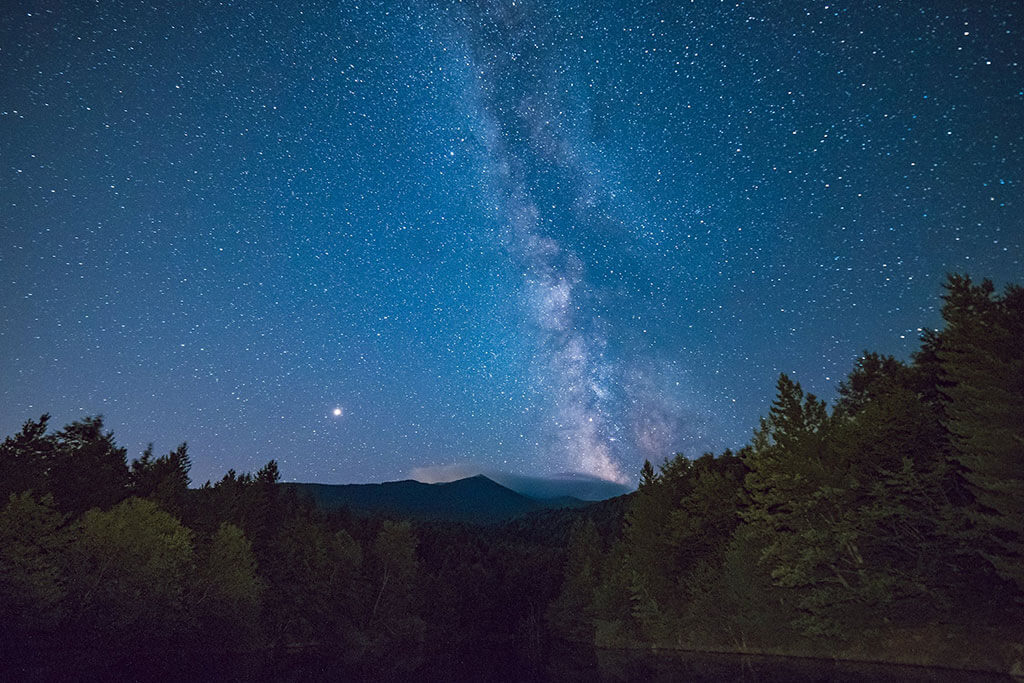
In the next few weeks, the moon can be seen close to all the bright planets. No telescope needed and visible in Toronto's night sky. See the attached presentation below for many more upcoming celestial events.
(Image courtesy Bill Longo)
It’s not very often that we get to experience a new meteor shower, but very early this coming Saturday morning we get that chance.
Essential information for the upcoming eclipse. Dr. Ralph Chou shows how to use solar eclipse viewers or glasses safely.
Essential information for the upcoming eclipse. Dr. Ralph Chou shows how to use solar filters for your telescope safely and make photos.
What is happening in the sky above? What space exploration is the human race up to? This overview was prepared by Chris Vaughan for our Recreational Astronomy Night, April 2014.
A lot of things happening overhead. There are many planets and comets to see. This overview was prepared by Chris Vaughan for our Recreational Astronomy Night, March 2014.
Royal Astronomical Society of Canada, Toronto Centre, invites all members and family members to join an orientation get together, named First Light. This is for all members who have not participated in this event before.
From mid-February to mid-March, there will be opportunities to see Jupiter, Mars, Saturn, Venus, and Mercury. Mars, in particular, will draw closer to us and get bigger and brighter, as it heads toward opposition in April.
The sky this month as presented by Chris Vaughan at the Recreational Astronomy night.
Launches, this month in history, star parties, the sun and moon, planets, comets, meteors, asteroids, satellites, occultations and winter highlights.
Hawking is the extraordinary story of the planet’s most famous living scientist, told for the first time in his own words and by those closest to him. Presented at TIFF, co-presented with the Perimeter Institute.
As of November 2013 we have four comets in the night sky that can be seen with simple telescopes and binoculars. One comet, named comet ISON is brightening rapidly and can be seen without optical aids (with the naked eye) from darker rural skies.
What is up in the sky this month? François van Heerden tells us all about the planets, objects you can see with binoculars, metero showers, comet ISON, Lovejoy, Encke and Linear, the moon and the upcoming MAVEN mission to Mars by NASA.
From mid-October to mid-November, there’s something going on just about every night and early morning. Enjoy double shadow transits on Jupiter. Capture the colours of Mars and Regulus. There are many comets visible to us in the Northern hemisphere, in addition to ISON. Watch the Olympic torch go for a spacewalk. Try to spot the faint moons of Uranus and Neptune. Take in the interesting and colourful planetary nebulae of the constellations of Andromeda, Pegasus, Perseus, Cetus, Pisces, Triangulum, and Aries.
Armstrong is a dramatic and emotional documentary that features never-before-seen family home-movie footage, along with still and moving images that chronicle Neil Armstrong’s incredible life.